Category: Wisdom Tooth

  • Is Wisdom Tooth Removal a Major Surgery?

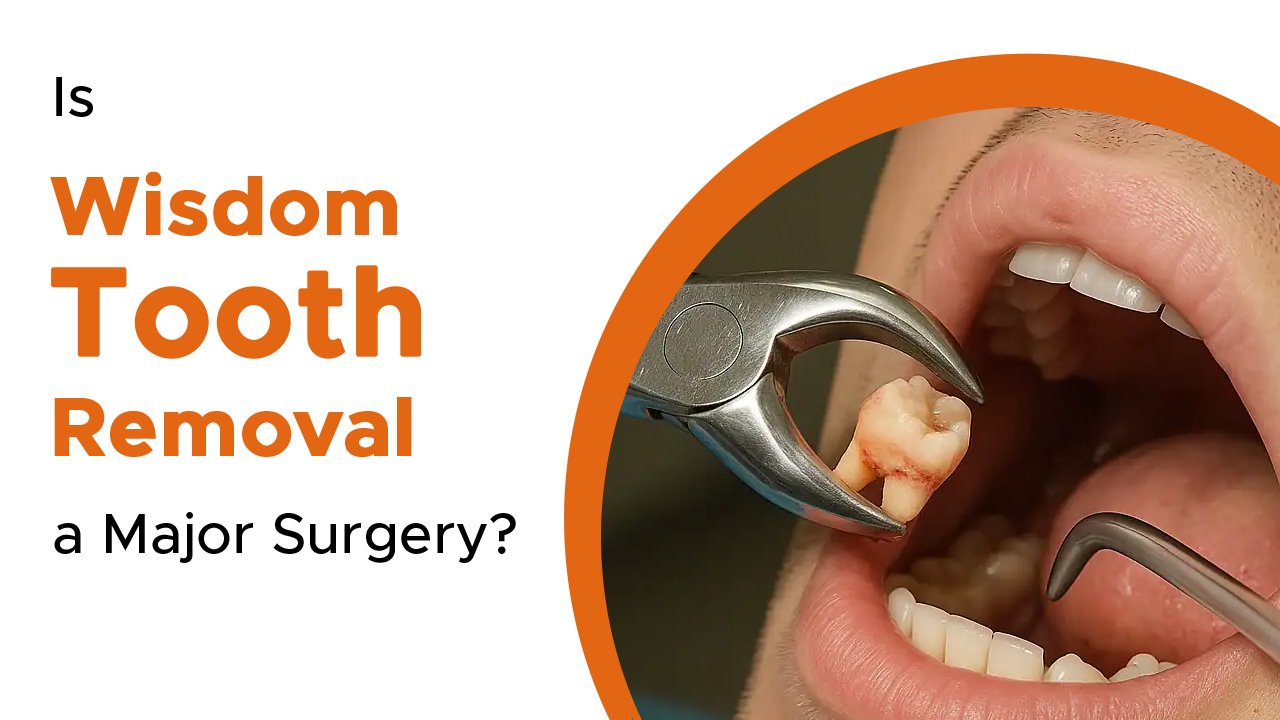
    Is Wisdom Tooth Removal a Major Surgery?

    The tooth has been hurting on and off for weeks. You Google it. You see the word “surgery.” You close the tab and hope the pain goes away. It doesn’t. So here you are again.

    This question comes up every single day in our consultation rooms at Eledent Dental Hospital. Patients delay for months, not because the procedure is dangerous, but because they don’t know what it actually involves.

    So here’s the answer: wisdom tooth removal is not major surgery. In most cases, it’s a same-day procedure done under local anaesthesia in a dental chair. You go home the same day. No hospital. No general anaesthesia. No operation theatre.

    At Eledent Dental Hospital, MDS-certified oral and maxillofacial surgeons handle wisdom tooth cases daily. Read on to understand what actually happens, when it gets more complex and what recovery looks like.

    What Counts as Major Surgery in Dentistry?

    Major oral surgery involves jaw reconstruction, facial trauma repair or tumour removal. These require general anaesthesia, a hospital theatre and often an overnight stay.

    Wisdom tooth removal doesn’t come close to that. It’s classified as minor oral surgery. It happens in a dental clinic, under local anaesthesia, in under an hour for most patients. The word “surgery” is technically accurate because an incision is sometimes involved. But the scale and risk profile are nowhere near what that word suggests to most people.
    simple-vs.-surgical-wisdom-tooth-removal

    Is Wisdom Tooth Removal Considered Major Surgery for Every Patient?

    No. The procedure varies based on how your tooth has grown.

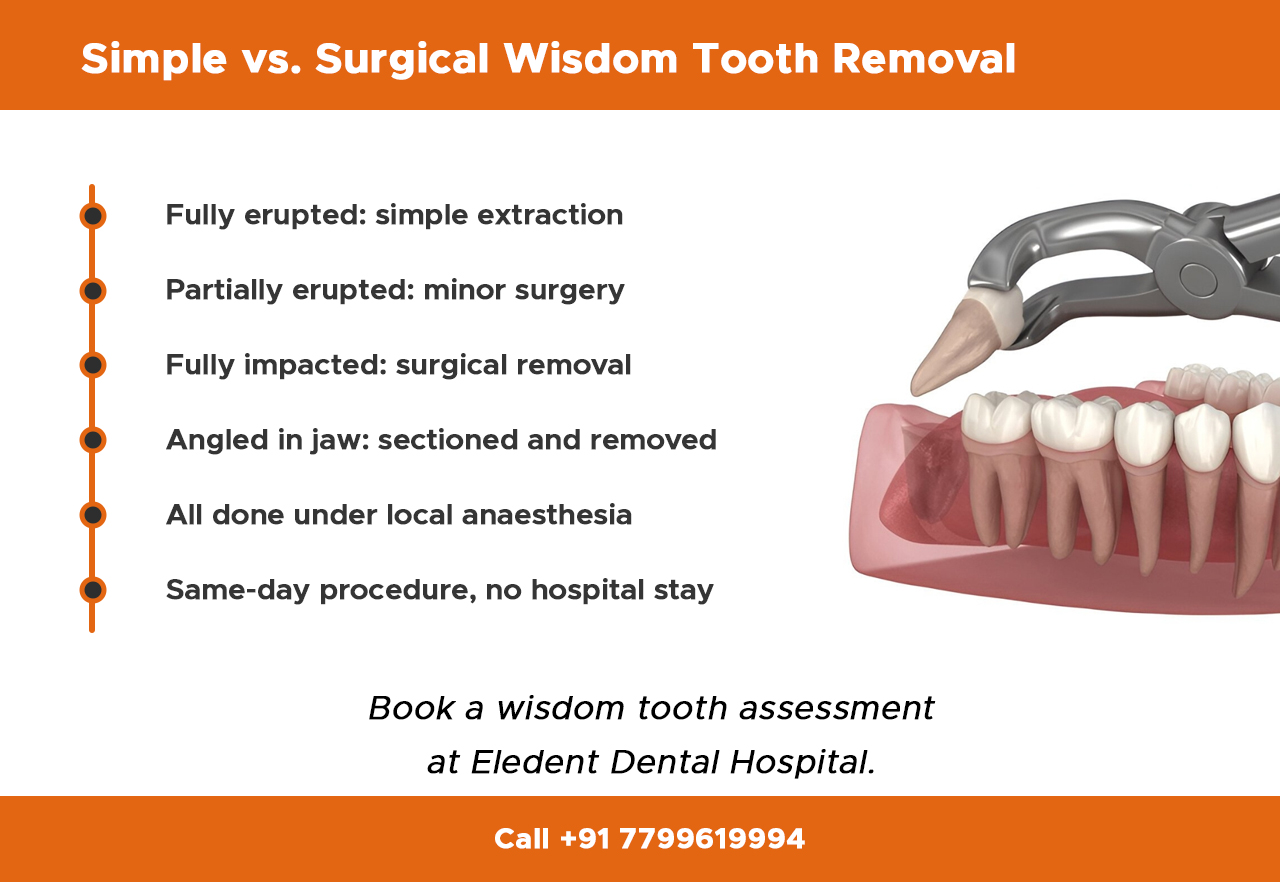
    Two patients can walk in with the same complaint and need completely different procedures. Here’s how complexity breaks down:

    Situation Procedure What Happens
    Tooth fully erupted, easy to reach Simple extraction Tooth loosened and removed directly
    Partially through the gum Minor surgical extraction Small incision, tooth removed cleanly
    Fully stuck under gum or bone Surgical extraction Gum incision, bone access if needed
    Angled or horizontal in the jaw Complex surgical extraction Tooth sectioned and removed in parts

    When a wisdom tooth lacks space to come through, it gets stuck. Dentists call this impaction. It’s the most common reason a removal becomes surgical rather than simple.

    Even in complex impaction cases, this is still a same-day procedure under local anaesthesia for the vast majority of patients.

    What Happens During Wisdom Tooth Removal, Step by Step?

    Knowing the exact process is one of the most effective ways to manage anxiety before your appointment. Here’s how it works at Eledent Dental Hospital:

    • Step 1: Imaging – The surgeon takes an OPG, which is a full-mouth panoramic X-ray, or a CBCT 3D scan where needed. This shows the tooth’s exact position, root shape and how close it sits to the nerve. No procedure starts without a clear picture of the anatomy.
    • Step 2: Local anaesthesia – The area is numbed completely. You feel pressure. You feel movement. You don’t feel pain. If anything feels sharp, you raise your hand and the surgeon stops immediately.
    • Step 3: Removal – For a simple case, the tooth is loosened and lifted out. For a surgical case, a small gum incision is made first. If the tooth is trapped in bone, a small amount of bone is cleared to access it. A heavily angled tooth may be sectioned into pieces and removed in parts.
    • Step 4: Closure – The site is cleaned. Stitches are placed if needed. Most are dissolvable.
    • Step 5: Instructions before you leave – You get clear guidance on what to eat, what to avoid and what to expect over the next few days.

    For patients with significant dental anxiety,conscious sedation is available at Eledent Dental Hospital. You stay awake and responsive, but feel calm enough to get through the procedure without distress. It’s not general anaesthesia. It’s a relaxation option for patients who need it.

    Does Wisdom Tooth Removal Hurt?

    During the procedure: No. Local anaesthesia controls sensation completely. You feel pressure and movement, which is normal. Sharp pain is not, and it gets addressed on the spot.

    After the procedure, some discomfort is expected and normal. Here’s what to expect:

    • Soreness and swelling for two to four days, peaking around day two
    • Jaw stiffness, especially in the morning
    • Mild bleeding for the first few hours
    • Some difficulty opening your mouth fully for a day or two

    These are not signs of something going wrong. They’re the body’s healing response.

    Watch out for these signs and call Eledent Dental Hospital if you notice:

    • Heavy bleeding that doesn’t slow down after 30 to 45 minutes of firm pressure
    • Severe throbbing pain starting three to four days after removal. This may be dry socket, where the blood clot at the extraction site dislodges before healing
    • Fever or increasing swelling after day three

    According to the American Association of Oral and Maxillofacial Surgeons, dry socket occurs in roughly 2 to 5 percent of routine extractions, and up to 30 percent of impacted lower wisdom tooth removals. Knowing the signs means you catch it early.

    Most patients recover fully within five to seven days. And almost every patient says the same thing after the procedure: the fear was far worse than what actually happened.

    When Should You Stop Waiting and Get It Checked?

    Not every wisdom tooth needs removal. If yours has erupted cleanly, sits well and is easy to clean, monitoring it is fine. But certain signs mean the tooth is already causing damage, and each week you wait adds to it.

    Get a dental check done if you have any of these:

    • Pain or throbbing at the back of the jaw that keeps coming back after settling
    • Swollen, tender or bleeding gums around your last molar
    • Food constantly trapping near the tooth despite regular brushing
    • A bad taste or persistent bad breath that doesn’t clear with brushing
    • Pain spreading toward the molar in front of your wisdom tooth
    • Swelling that reduces and returns, again and again

    That last point often points to pericoronitis, an infection of the gum flap over a partially erupted tooth. According to a 2022 review published in the British Dental Journal, pericoronitis is most common in patients aged 20 to 29 and is one of the leading clinical reasons for wisdom tooth removal in young adults. Each flare-up affects the surrounding bone and neighbouring teeth. Waiting doesn’t reduce complexity. It adds to it.

    How Does Eledent Dental Hospital Handle Wisdom Tooth Removal?

    At Eledent Dental Hospital, every wisdom tooth case starts with proper imaging. The surgeon assesses tooth position, root shape and nerve proximity before forming any plan. Treatment is explained to you fully before anything is scheduled.

    • Where clinically appropriate, Eledent Dental Hospital uses atraumatic extraction techniques. This is a controlled, precise approach that removes the tooth with minimal disruption to surrounding gum and bone. It matters especially if you’re considering a dental implant or any restoration at the same site later.
    • Conscious sedation is available for anxious patients across all branches. Every step is explained before it happens.

    If you’ve been looking for wisdom teeth removal in Hyderabad and aren’t sure what your case involves, a consultation at Eledent Dental Hospital is the right first step. Our surgeon reviews your imaging, explains exactly what type of removal you need and walks you through the entire process before you commit to anything.

    Eledent Dental Hospital branches for wisdom tooth extraction in Hyderabad:

    If the pain at the back of your jaw keeps returning, don’t wait for the next flare-up. Book a wisdom tooth assessment at your nearest Eledent Dental Hospital branch. Call +91 7799619994 to schedule a consultation.

    Frequently Asked Questions

    Is wisdom tooth removal considered major surgery?

    No. It’s minor oral surgery done under local anaesthesia in a dental chair.
    No hospital admission and no general anaesthesia needed in most cases.
    Complexity depends on tooth position, confirmed after imaging at Eledent Dental Hospital.

    Can I eat before wisdom tooth removal?

    Yes, for procedures under local anaesthesia. Avoid eating heavily right before.
    If conscious sedation is planned, your Eledent Dental Hospital surgeon gives you
    specific fasting instructions at the pre-procedure consultation.

    How soon can I return to work after wisdom tooth removal?

    Most patients return to desk work within one to two days. Avoid physical work
    or strenuous activity for four to five days. Your Eledent Dental Hospital surgeon
    confirms the right timeline based on your case.

    What is dry socket and how do I avoid it?

    Dry socket happens when the blood clot at the extraction site dislodges before
    the wound heals, exposing the bone underneath. Avoid smoking, using straws or
    spitting hard for 48 hours after the procedure.

    Does removing one wisdom tooth mean the others come out too?

    No. Each wisdom tooth is assessed separately. Eledent Dental Hospital surgeons
    only recommend removal when a specific tooth is clinically problematic.
    The others are monitored independently.

    Can wisdom teeth be removed safely if I have diabetes or a medical condition?

    Yes, in most cases, with proper pre-treatment assessment. At Eledent Dental Hospital,
    patients with medical conditions are evaluated before any surgical procedure.
    The surgeon reviews your health history and adjusts the plan accordingly.
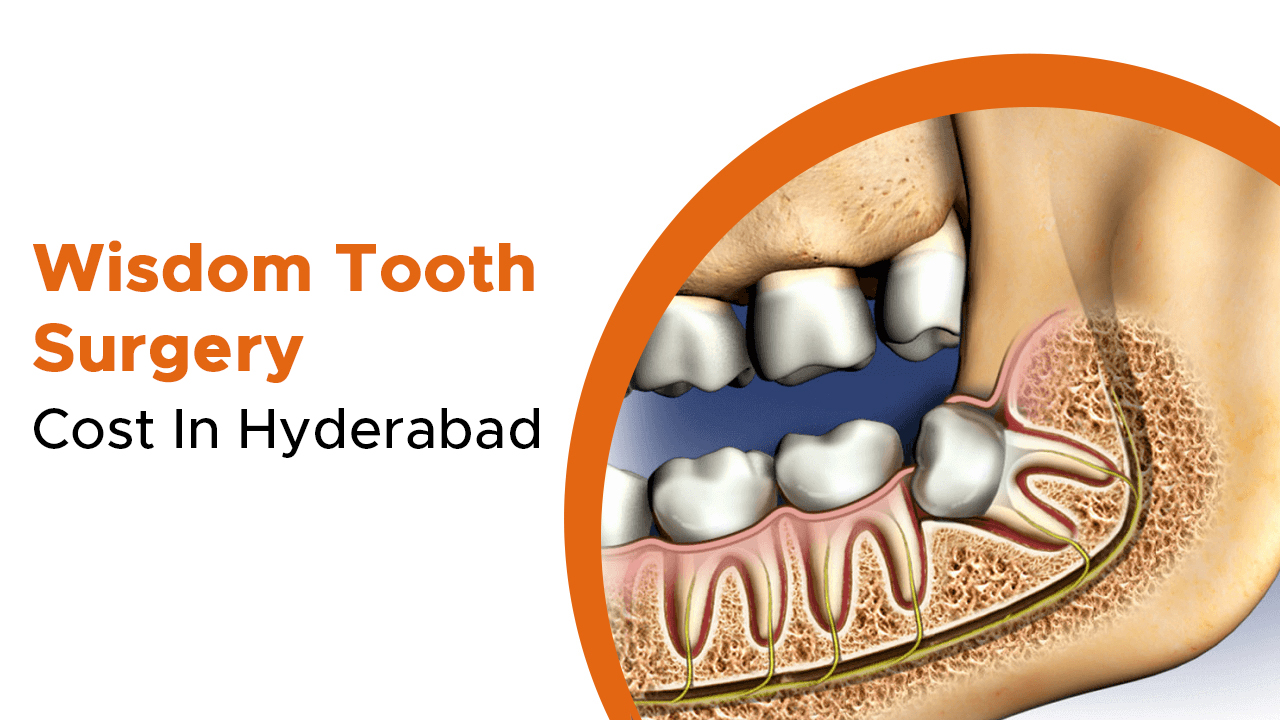
  • Wisdom Tooth Surgery Cost In Hyderabad

    Wisdom Tooth Surgery Cost In Hyderabad

    Pain at the back of the jaw can make chewing, swallowing, sleeping, and even opening the mouth feel difficult. Most people do not just want the tooth removed. They want to know the real cost, whether surgery is necessary, and how to avoid choosing the wrong clinic.

    The direct answer is that wisdom tooth surgery cost breakdown in Hyderabad usually falls between ₹3,000 and ₹15,000 per tooth, depending on impaction depth, tooth angle, surgical difficulty, and imaging needs.

    At Eledent Dental Hospitals, patients benefit from 19+ years of clinical experience, 30,000+ smiles restored, and access across 5 Hyderabad locations for timely care. This blog is written by an expert dentist from Eledent Dental Hospitals.

    Read on to understand what affects the fee, what the quote should include, and how to choose safer treatment with more confidence.

    How Much Does Wisdom Tooth Surgery Cost In Hyderabad?

    The direct answer is that wisdom tooth surgery in Hyderabad usually costs between ₹3,000 and ₹15,000 per tooth. The price changes because not all wisdom teeth are removed in the same way.

    A fully erupted tooth that is easy to grip and deliver usually costs much less than a tooth buried inside bone, tilted sideways, or positioned close to the mandibular nerve. In real terms, the quote reflects surgical difficulty more than pain level.

    Type Of Removal What The Dentist Usually Has To Do Cost Range
    Simple extraction Loosen and remove a visible tooth ₹2,000 to ₹4,500
    Soft tissue impaction Open a small gum flap to access the crown ₹4,000 to ₹7,000
    Partial bony impaction Remove some bone and deliver the tooth carefully ₹6,000 to ₹10,000
    Complete bony impaction Raise a flap, remove more bone, section the tooth if needed ₹8,000 to ₹12,000+
    Horizontal or complex impaction Section the tooth and protect nearby nerve or second molar area ₹7,000 to ₹15,000+

    Patients comparing wisdom teeth removal in Hyderabad often see very different quotes online. That usually happens because one quote is for a straightforward extraction, while another includes flap elevation, bone guttering, tooth sectioning, sutures, medicines, and follow-up review.

    What Is The Cost Difference Between Simple Extraction And Surgical Wisdom Tooth Removal?

    The simple extraction costs less because the tooth is easier to access and remove. Surgical removal costs more because the dentist may need to open the gum, remove bone, or divide the tooth before taking it out.

    Simple extraction Surgical removal
    The tooth is fully visible in the mouth. The tooth is partly or fully trapped under gum or bone.
    The dentist can usually remove it without cutting the gum. The dentist may need to open the gum to reach the tooth.
    Bone removal is usually not needed. Some bone may need to be removed for access.
    The tooth often comes out in one piece. The tooth may need to be divided into smaller sections before removal.
    The procedure is usually quicker. The procedure usually takes more time because it is more complex.
    Recovery is often simpler and faster. Recovery may take longer because the surgical site is deeper.
    The cost is usually lower. The cost is usually higher because the case needs more planning and surgical work.

    What Factors Affect The Cost Of Wisdom Tooth Surgery?

    The main factors are impaction depth, tooth angle, root shape, nerve proximity, imaging needs, surgical time, and whether the case needs a more advanced approach.

    A wisdom tooth that is fully erupted usually takes less time and fewer instruments. A tooth that lies at a 90-degree angle against the second molar often needs more planning, more bone removal, and more controlled sectioning. That increases both treatment time and clinical difficulty.

    The biggest cost drivers are:

    • Impaction level: A tooth under gum alone usually costs less than one buried in bone.
    • Tooth angulation: Vertical teeth are often easier than mesioangular, distoangular, or horizontal impactions.
    • Root anatomy: Curved, divergent, or bulbous roots can make removal harder.
    • Nerve relation: Lower wisdom teeth near the inferior alveolar nerve may need more careful planning.
    • Imaging type: OPG may be enough in many cases, but CBCT adds detail when the nerve or root position needs closer study.
    • Surgical steps: Bone cutting, flap elevation, tooth sectioning, irrigation, and suturing all add to complexity.
    • Sedation needs: Advanced sedation raises the total cost beyond local anesthesia alone.
    • Number of teeth removed: Removing two or four teeth together changes both planning and cost.

    A patient exploring wisdom teeth removal in Kukatpally may first hear a basic estimate, then receive a different final quote after imaging shows deep impaction or close nerve relation. That is not random pricing. It reflects the actual surgical work needed. At Eledent, digital X-rays help the team assess the angle of the tooth, the relation to nearby structures, and the safest removal method before treatment begins.

    What Is Included In The Cost Of Wisdom Tooth Surgery?

    The total cost usually includes diagnosis, imaging review, local anesthesia, the surgical removal itself, and basic follow-up care.

    Patients often compare only the extraction fee, but the actual value lies in what the quote covers. A proper wisdom tooth surgery fee should not sound vague. It should tell you what is included before treatment begins.

    A standard quote may include:

    • Consultation and oral examination.
    • OPG review, or CBCT advice if required.
    • Local anesthesia for the procedure.
    • Gum opening and bone removal if needed.
    • Tooth sectioning if the crown or roots cannot be removed in one piece.
    • Sutures if the site needs closure.
    • Basic medicines for pain and swelling control.
    • One review visit for healing assessment.

    When Can The Cost Go Higher Than Expected?

    The cost usually rises when the tooth is deeper, more difficult, closer to the nerve, or more surgically demanding than it first appeared.

    This happens most often in lower wisdom teeth with deep bony impaction, sideways angulation, or close proximity to the nerve canal. A case may also become more expensive if multiple teeth are removed in one session or if advanced sedation is added.

    Situations that can increase the cost include:

    • Deep complete bony impaction.
    • Horizontal tooth position.
    • Roots close to the inferior alveolar nerve.
    • Need for CBCT after OPG review.
    • More bone removal than first expected.
    • Tooth sectioning into multiple pieces.
    • Removal of two or four wisdom teeth together.
    • Additional sedation beyond local anesthesia.

    Patients asking for a wisdom tooth surgery cost breakdown in Hyderabad should not judge value only by the lowest number. A lower quote that excludes imaging, sutures, medicines or review visits may not stay lower by the end.

    How Do You Choose The Right Dentist For Wisdom Tooth Removal In Hyderabad?

    The right dentist is the one who can read the imaging properly, explain the difficulty honestly, plan the surgery safely, and manage healing well after removal.

    Cost matters, but surgery safety matters more. A wisdom tooth close to the nerve, second molar, or sinus should not be treated like a routine tooth extraction. The planning stage tells you a lot about the clinic.

    Check these points before choosing:

    • The case is assessed with OPG, and CBCT is advised when the nerve or root position is unclear.
    • The dentist explains whether it is a simple extraction or a surgical impaction case.
    • The clinic can describe the tooth angle clearly, such as vertical, mesioangular, distoangular, or horizontal.
    • The quote includes what is covered and what may raise the price.
    • The surgical setup is sterile and structured.
    • The aftercare instructions are clear and specific.
    • Follow-up support is available if swelling, limited mouth opening, or dry socket symptoms appear.

    If you are comparing wisdom teeth removal in Manikonda, ask who will actually perform the surgery, what imaging will be used, and whether the estimate already includes the expected surgical steps.

    How Is Wisdom Tooth Surgery Planned Step By Step?

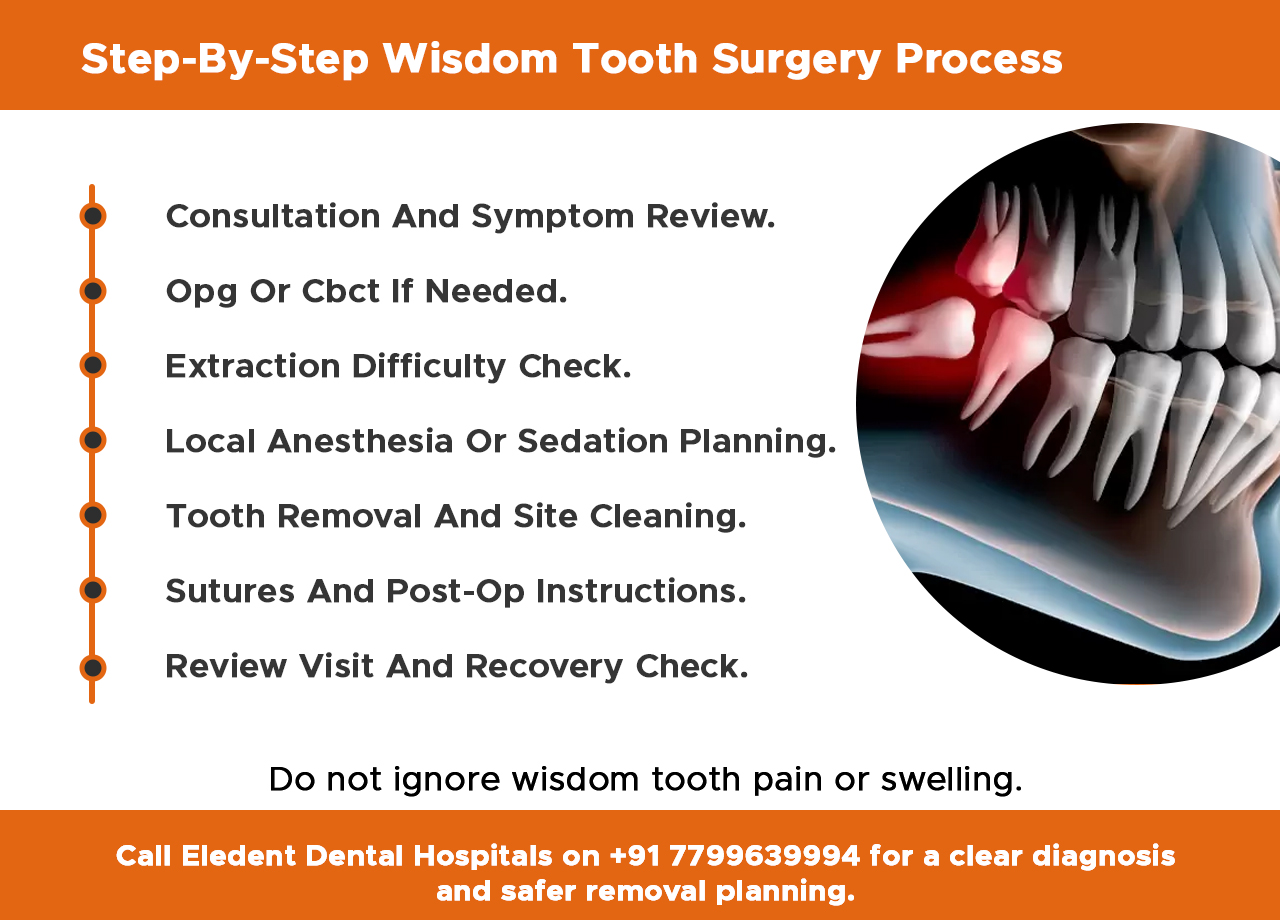
    Wisdom tooth surgery is planned through symptom review, imaging, difficulty assessment, anesthesia planning, removal, closure, and follow-up.

    A good surgery plan is not rushed. The pain level alone does not tell the full story. Some teeth hurt badly even when removal is simple. Others cause mild symptoms but turn out to be deeply impacted on imaging.

    Consultation and Symptom Review

    The dentist checks pain, swelling, food lodgement, mouth opening, gum infection, and pressure on the second molar.


    Imaging and Difficulty Assessment

    An OPG is commonly used first. If the roots appear close to the nerve canal or the anatomy looks unclear, a CBCT may be advised for better 3D assessment.


    Surgical Planning

    The dentist decides whether the case needs a flap, bone removal, sectioning, local anesthesia alone, or extra sedation support.


    Tooth Removal and Site Cleaning

    The gum is opened if needed, the bone is trimmed in a controlled way, the tooth is delivered whole or in sections, and the site is cleaned thoroughly.


    Sutures and Post-op Instructions

    If the area needs closure, sutures are placed. The patient is then given instructions on gauze pressure, ice pack timing, food texture, mouth opening care, and medicine use.


    Review Visit and Healing Check

    A follow-up visit checks swelling control, healing progress, and whether the socket is settling normally.


    step-by-step-wisdom-tooth-surgery-process

    Choose Eledent Dental Hospitals For Safer Wisdom Tooth Surgery In Hyderabad

    Jaw pain, swelling, food lodgement, or difficulty opening the mouth should not be ignored when a wisdom tooth is trapped or infected. Get a safer treatment plan with Eledent Dental Hospitals, where wisdom tooth cases are assessed with digital OPG support, CBCT when deeper nerve planning is needed, surgeon-led evaluation, and clear post-op guidance with follow-up support.

    If you need safer wisdom teeth removal in Banjara Hills or wisdom teeth removal in Kompally, choose Eledent Dental Hospitals and call +91 7799639994 for a clearer estimate and a better surgical plan.

    FAQ

    Can I go to work the next day after wisdom tooth surgery?

    Many people can return to light work the next day if the surgery was simple. If the removal was deeper or more difficult, resting for a day or two is often better.

    Will wisdom tooth surgery change my face shape?

    No, it will not change your face shape in any major way. You may notice temporary swelling after surgery, but that settles as healing improves.

    Can I brush my teeth on the day of wisdom tooth surgery?

    Yes, but do it carefully. Avoid brushing directly over the surgical area on the first day and keep the rest of your mouth as clean as possible.

    Is bad breath normal after wisdom tooth removal?

    A mild bad smell can happen for a short time during healing. If the smell becomes strong or stays for days, the area should be checked.

    Can I get all four wisdom teeth removed in one visit?

    Yes, that is possible in many cases. The decision depends on pain level, tooth position, overall health, and the surgeon’s plan.

  • Get Your Wisdom Tooth Removed to Prevent Tooth Loss

    Get Your Wisdom Tooth Removed to Prevent Tooth Loss

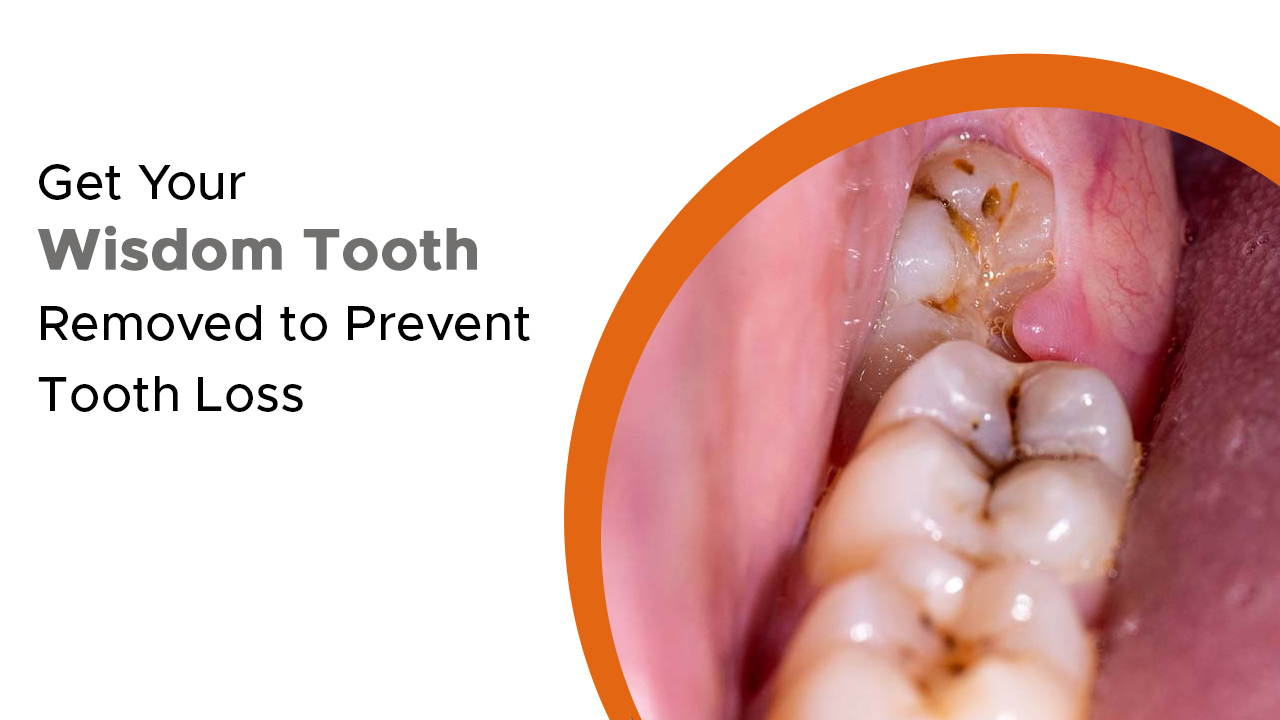
    The mild pain at the back of your jaw is easy to brush off at first. In many cases, it is an early sign of an impacted or infected wisdom tooth. If it is left untreated, it can slowly damage the molar next to it.

    If your goal is to prevent tooth loss, extraction of wisdom teeth is often the right step once impaction, infection, or decay is confirmed. A proper dental exam and an X-ray usually show what is happening and what should be done next.

    At Eledent Dental, the approach is simple: diagnose early, plan clearly, and treat safely. Our team for wisdom tooth extraction in Hyderabad, uses scan-based evaluation and a structured treatment plan so you are not guessing or delaying.

    Read this blog by the experts at Eledent Dental to understand why wisdom teeth cause damage, the main reasons removal is advised, what happens if you wait, how the procedure is done, and what recovery looks like.

    Why Is Removing a Wisdom Tooth Important to Prevent Tooth Loss?

    Removing an impacted wisdom tooth protects the nearby molar from hidden decay, repeated gum infection, and bone loss that can lead to tooth loss. The tricky part is that damage can build up even when the pain feels on and off.

    By the time swelling or any kind of severe pain appears, damage may already reach to its advance. Early action is simple: ‘protect the healthy tooth before it becomes complicated.

    6 Main Reasons to Get Your Wisdom Teeth Removed

    Dentists recommend removal when the wisdom tooth is repeatedly causing infection, damaging the second molar, or threatens gum and bone health. Below are the most common reasons to get your wisdom teeth removed:

    1. Repeated Gum Infection (Pericoronitis)

    If the gum around a partially erupted wisdom tooth keeps swelling, the infection generally returns. Food and bacteria get trapped under the gum flap, leading to pain, bad taste, and difficulty in opening the mouth. When the source of infection remains, antibiotics may only provide a temporary relief.

    2. Damage to the Nearby Tooth (Second Molar)

    An impacted wisdom tooth can also damage the tooth in front of it. Brushing alone cannot fully clean the tight contact area, allowing the decay to form unnoticed. Many patients feel surprised when an X-ray reveals a deep cavity near their second molar which didn’t cause pain. Removing this affected wisdom tooth early helps protect the second molar from turning into a bigger issue later.

    3. Bone Loss Risk

    Long-term inflammation can slowly dissolve the supporting bone near the adjacent molar. This bone loss matters because reduced support increases the chance of gum pockets, tooth sensitivity, and tooth mobility over time.

    4. Cyst Formation

    In some patients’ cases, impacted wisdom teeth develop a cyst around it. These cysts can expand and damage surrounding bone and roots. Thus, extraction of wisdom teeth early prevents avoidable bone destruction.

    5. Orthodontic Crowding or Relapse Risk

    Wisdom teeth can add pressure, especially at the back of the jaw. If one has aligners or braces, your dentist may recommend removal to protect alignment and reduce relapse risk.

    6. Severe Decay or Unrestorable Wisdom Tooth

    Sometimes a wisdom tooth has a deep decay and cannot be cleaned or filled properly, because of its position.. In such cases, removal becomes the safest option.

    What Happens if Not Opt for Extraction of Wisdom Teeth?

    Delaying the extraction of wisdom teeth can increase the chances of infection spreading and damaging the nearby molar. It can also make the process harder because roots become developed and the surrounding bones become denser.

    Is Wisdom Tooth Removal Process Painful?

    Wisdom tooth removal treatment is generally a comfortable procedure because the area is fully numbed using anesthesia. Most patients feel pressure, and not sharp pain. Remember, fear often comes from stories and not personal experience

    What is the Process for Wisdom Tooth Removal?

    The extraction of wisdom teeth usually follows a simple, planned sequence. The process includes examination, X-ray planning, anesthesia, removal, and aftercare. Knowing the steps helps set the right expectations and reduces anxiety.

    1. Clinical check-up and digital X-ray.
    2. Assessment of tooth position and nerve proximity.
    3. Local anesthesia for numbness.
    4. Gentle removal of the tooth.
    5. Cleaning and stitches if needed.
    6. Aftercare instructions.

    How Long Does it Take to Recover After Wisdom Tooth Removal?

    Most people feel better in 3 to 5 days, while gum healing continues over the next 1 to 2 weeks. Soft food, gentle brushing, and good rest make a measurable difference. If pain or swelling worsens after day three, get reviewed.

    If you are considering wisdom teeth removal in Banjara Hills, planning the removal earlier often means smoother recovery compared to waiting until infection becomes complex.

    Protect Your Natural Teeth Before It’s Too Late. Book Your Wisdom Tooth Removal in Hyderabad Now! 

    Your wisdom tooth should not cost you a healthy second molar. If symptoms keep coming back, do not wait for the situation to escalate.
    Early extraction of wisdom teeth helps protect bone, limits infection spread, and reduces long-term complications.

    At Eledent Dental, we focus on:

    If you are searching for wisdom tooth extraction in Hyderabad, schedule a consultation with Eledent Dental and get clarity before the damage spreads. Call +91 77996 19994.