The tooth has been hurting on and off for weeks. You Google it. You see the word “surgery.” You close the tab and hope the pain goes away. It doesn’t. So here you are again.
This question comes up every single day in our consultation rooms at Eledent Dental Hospital. Patients delay for months, not because the procedure is dangerous, but because they don’t know what it actually involves.
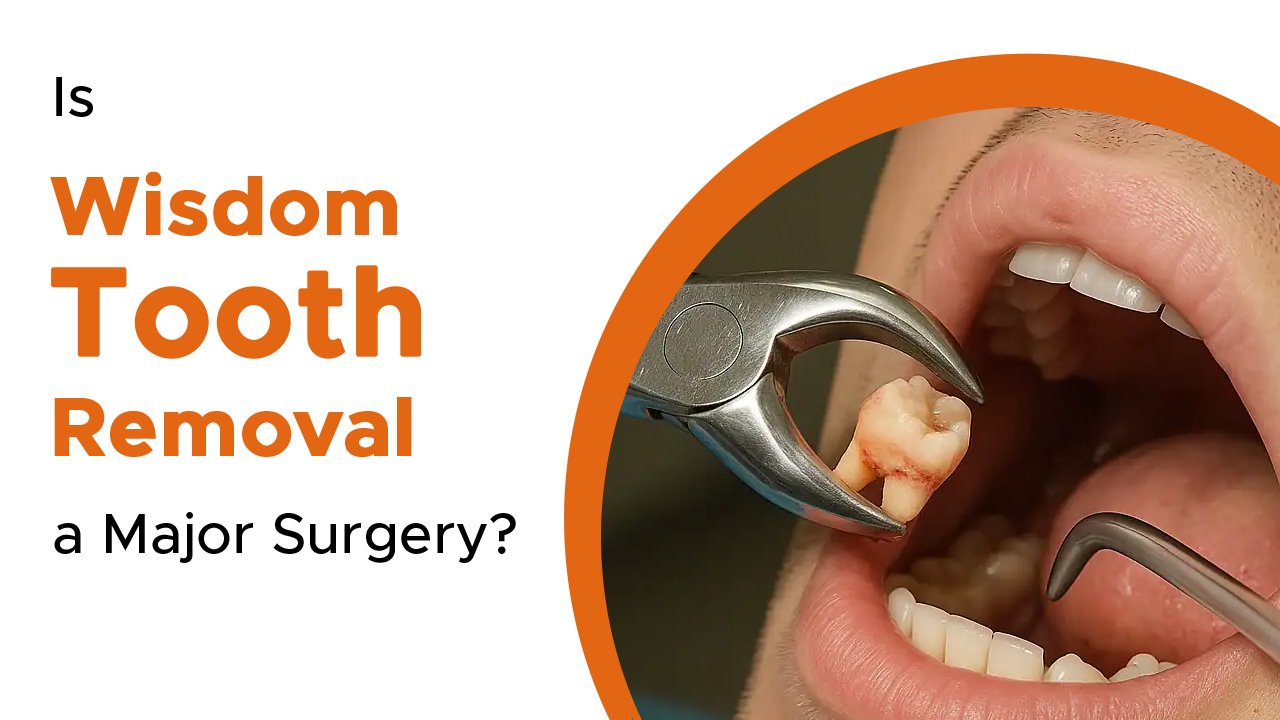
So here’s the answer: wisdom tooth removal is not major surgery. In most cases, it’s a same-day procedure done under local anaesthesia in a dental chair. You go home the same day. No hospital. No general anaesthesia. No operation theatre.
At Eledent Dental Hospital, MDS-certified oral and maxillofacial surgeons handle wisdom tooth cases daily. Read on to understand what actually happens, when it gets more complex and what recovery looks like.
What Counts as Major Surgery in Dentistry?
Major oral surgery involves jaw reconstruction, facial trauma repair or tumour removal. These require general anaesthesia, a hospital theatre and often an overnight stay.
Wisdom tooth removal doesn’t come close to that. It’s classified as minor oral surgery. It happens in a dental clinic, under local anaesthesia, in under an hour for most patients. The word “surgery” is technically accurate because an incision is sometimes involved. But the scale and risk profile are nowhere near what that word suggests to most people.
Is Wisdom Tooth Removal Considered Major Surgery for Every Patient?
No. The procedure varies based on how your tooth has grown.
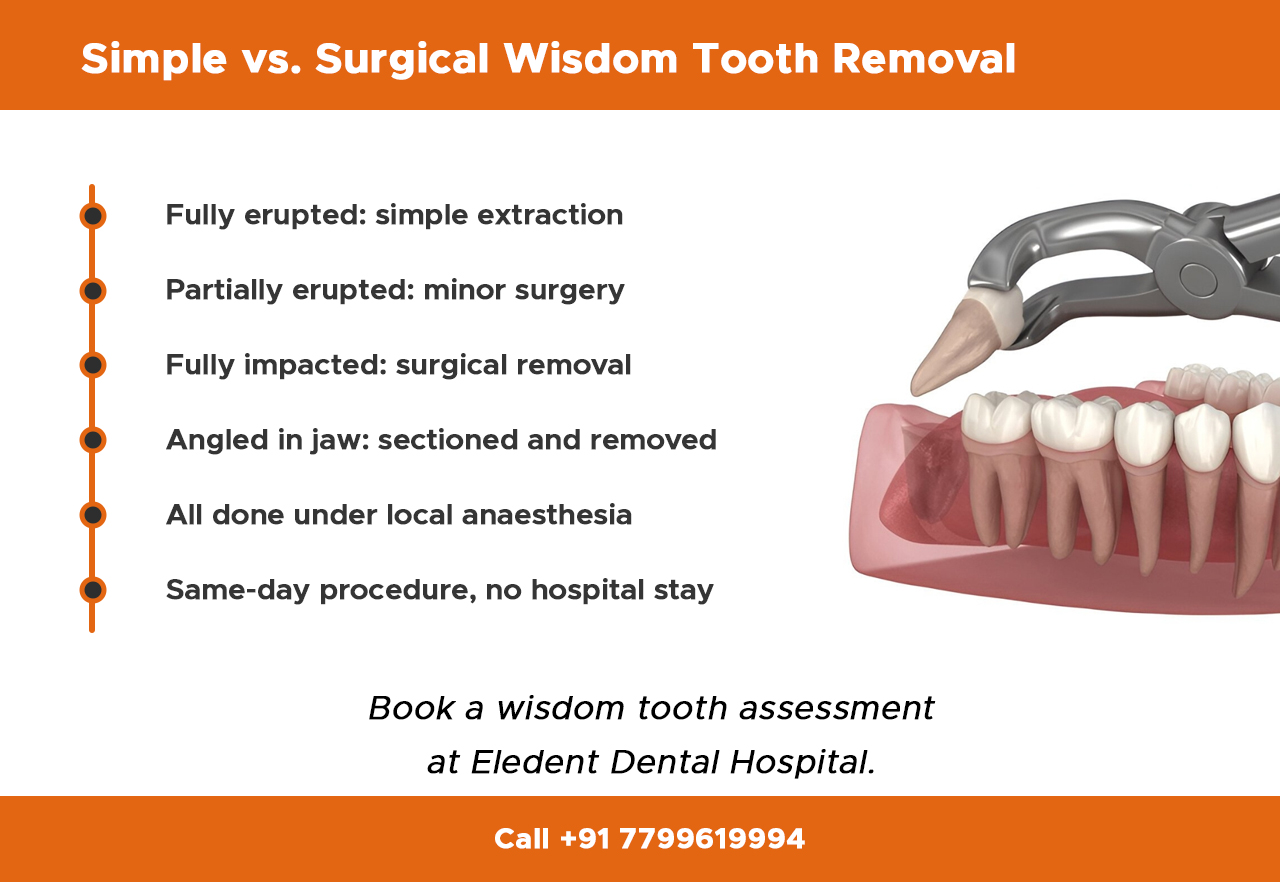
Two patients can walk in with the same complaint and need completely different procedures. Here’s how complexity breaks down:
| Situation | Procedure | What Happens |
|---|---|---|
| Tooth fully erupted, easy to reach | Simple extraction | Tooth loosened and removed directly |
| Partially through the gum | Minor surgical extraction | Small incision, tooth removed cleanly |
| Fully stuck under gum or bone | Surgical extraction | Gum incision, bone access if needed |
| Angled or horizontal in the jaw | Complex surgical extraction | Tooth sectioned and removed in parts |
When a wisdom tooth lacks space to come through, it gets stuck. Dentists call this impaction. It’s the most common reason a removal becomes surgical rather than simple.
Even in complex impaction cases, this is still a same-day procedure under local anaesthesia for the vast majority of patients.
What Happens During Wisdom Tooth Removal, Step by Step?
Knowing the exact process is one of the most effective ways to manage anxiety before your appointment. Here’s how it works at Eledent Dental Hospital:
- Step 1: Imaging – The surgeon takes an OPG, which is a full-mouth panoramic X-ray, or a CBCT 3D scan where needed. This shows the tooth’s exact position, root shape and how close it sits to the nerve. No procedure starts without a clear picture of the anatomy.
- Step 2: Local anaesthesia – The area is numbed completely. You feel pressure. You feel movement. You don’t feel pain. If anything feels sharp, you raise your hand and the surgeon stops immediately.
- Step 3: Removal – For a simple case, the tooth is loosened and lifted out. For a surgical case, a small gum incision is made first. If the tooth is trapped in bone, a small amount of bone is cleared to access it. A heavily angled tooth may be sectioned into pieces and removed in parts.
- Step 4: Closure – The site is cleaned. Stitches are placed if needed. Most are dissolvable.
- Step 5: Instructions before you leave – You get clear guidance on what to eat, what to avoid and what to expect over the next few days.
For patients with significant dental anxiety,conscious sedation is available at Eledent Dental Hospital. You stay awake and responsive, but feel calm enough to get through the procedure without distress. It’s not general anaesthesia. It’s a relaxation option for patients who need it.
Does Wisdom Tooth Removal Hurt?
During the procedure: No. Local anaesthesia controls sensation completely. You feel pressure and movement, which is normal. Sharp pain is not, and it gets addressed on the spot.
After the procedure, some discomfort is expected and normal. Here’s what to expect:
- Soreness and swelling for two to four days, peaking around day two
- Jaw stiffness, especially in the morning
- Mild bleeding for the first few hours
- Some difficulty opening your mouth fully for a day or two
These are not signs of something going wrong. They’re the body’s healing response.
Watch out for these signs and call Eledent Dental Hospital if you notice:
- Heavy bleeding that doesn’t slow down after 30 to 45 minutes of firm pressure
- Severe throbbing pain starting three to four days after removal. This may be dry socket, where the blood clot at the extraction site dislodges before healing
- Fever or increasing swelling after day three
According to the American Association of Oral and Maxillofacial Surgeons, dry socket occurs in roughly 2 to 5 percent of routine extractions, and up to 30 percent of impacted lower wisdom tooth removals. Knowing the signs means you catch it early.
Most patients recover fully within five to seven days. And almost every patient says the same thing after the procedure: the fear was far worse than what actually happened.
When Should You Stop Waiting and Get It Checked?
Not every wisdom tooth needs removal. If yours has erupted cleanly, sits well and is easy to clean, monitoring it is fine. But certain signs mean the tooth is already causing damage, and each week you wait adds to it.
Get a dental check done if you have any of these:
- Pain or throbbing at the back of the jaw that keeps coming back after settling
- Swollen, tender or bleeding gums around your last molar
- Food constantly trapping near the tooth despite regular brushing
- A bad taste or persistent bad breath that doesn’t clear with brushing
- Pain spreading toward the molar in front of your wisdom tooth
- Swelling that reduces and returns, again and again
That last point often points to pericoronitis, an infection of the gum flap over a partially erupted tooth. According to a 2022 review published in the British Dental Journal, pericoronitis is most common in patients aged 20 to 29 and is one of the leading clinical reasons for wisdom tooth removal in young adults. Each flare-up affects the surrounding bone and neighbouring teeth. Waiting doesn’t reduce complexity. It adds to it.
How Does Eledent Dental Hospital Handle Wisdom Tooth Removal?
At Eledent Dental Hospital, every wisdom tooth case starts with proper imaging. The surgeon assesses tooth position, root shape and nerve proximity before forming any plan. Treatment is explained to you fully before anything is scheduled.
- Where clinically appropriate, Eledent Dental Hospital uses atraumatic extraction techniques. This is a controlled, precise approach that removes the tooth with minimal disruption to surrounding gum and bone. It matters especially if you’re considering a dental implant or any restoration at the same site later.
- Conscious sedation is available for anxious patients across all branches. Every step is explained before it happens.
If you’ve been looking for wisdom teeth removal in Hyderabad and aren’t sure what your case involves, a consultation at Eledent Dental Hospital is the right first step. Our surgeon reviews your imaging, explains exactly what type of removal you need and walks you through the entire process before you commit to anything.
Eledent Dental Hospital branches for wisdom tooth extraction in Hyderabad:
- Wisdom teeth removal in Kondapur — K1 Prime Building, near Kondapur Bus Stop. Accessible from Madhapur, Hafeezpet and Gachibowli
- Wisdom teeth removal in Kukatpally — Opposite Holistic Hospital, KPHB Phase 1. Close to KPHB Metro Station, convenient for Nizampet, Miyapur and Pragathi Nagar
- Wisdom teeth removal in Manikonda — Above KFC, Manikonda Road. Accessible from Khajaguda, Puppalguda and Narsingi
- Wisdom teeth removal in Banjara Hills — Road No. 12, Sri Ram Nagar Colony. Accessible from Jubilee Hills, Film Nagar and Mehdipatnam
- Wisdom teeth removal in Kompally — Opposite Cinepolis, Suchitra Road. Serving Bowenpally, Secunderabad and surrounding areas
If the pain at the back of your jaw keeps returning, don’t wait for the next flare-up. Book a wisdom tooth assessment at your nearest Eledent Dental Hospital branch. Call +91 7799619994 to schedule a consultation.
Frequently Asked Questions
Is wisdom tooth removal considered major surgery?
No. It’s minor oral surgery done under local anaesthesia in a dental chair.
No hospital admission and no general anaesthesia needed in most cases.
Complexity depends on tooth position, confirmed after imaging at Eledent Dental Hospital.
Can I eat before wisdom tooth removal?
Yes, for procedures under local anaesthesia. Avoid eating heavily right before.
If conscious sedation is planned, your Eledent Dental Hospital surgeon gives you
specific fasting instructions at the pre-procedure consultation.
How soon can I return to work after wisdom tooth removal?
Most patients return to desk work within one to two days. Avoid physical work
or strenuous activity for four to five days. Your Eledent Dental Hospital surgeon
confirms the right timeline based on your case.
What is dry socket and how do I avoid it?
Dry socket happens when the blood clot at the extraction site dislodges before
the wound heals, exposing the bone underneath. Avoid smoking, using straws or
spitting hard for 48 hours after the procedure.
Does removing one wisdom tooth mean the others come out too?
No. Each wisdom tooth is assessed separately. Eledent Dental Hospital surgeons
only recommend removal when a specific tooth is clinically problematic.
The others are monitored independently.
Can wisdom teeth be removed safely if I have diabetes or a medical condition?
Yes, in most cases, with proper pre-treatment assessment. At Eledent Dental Hospital,
patients with medical conditions are evaluated before any surgical procedure.
The surgeon reviews your health history and adjusts the plan accordingly.
Leave a Reply